A new way to fly hydrated
AIRUS reached fielding in early 2025 with seven interface shapes, a pump sized to real flow rates and an 1800 mL bag. It is the end of a design road that started by asking women what the problem actually was — and the answer was never “a smaller version of the male one.”
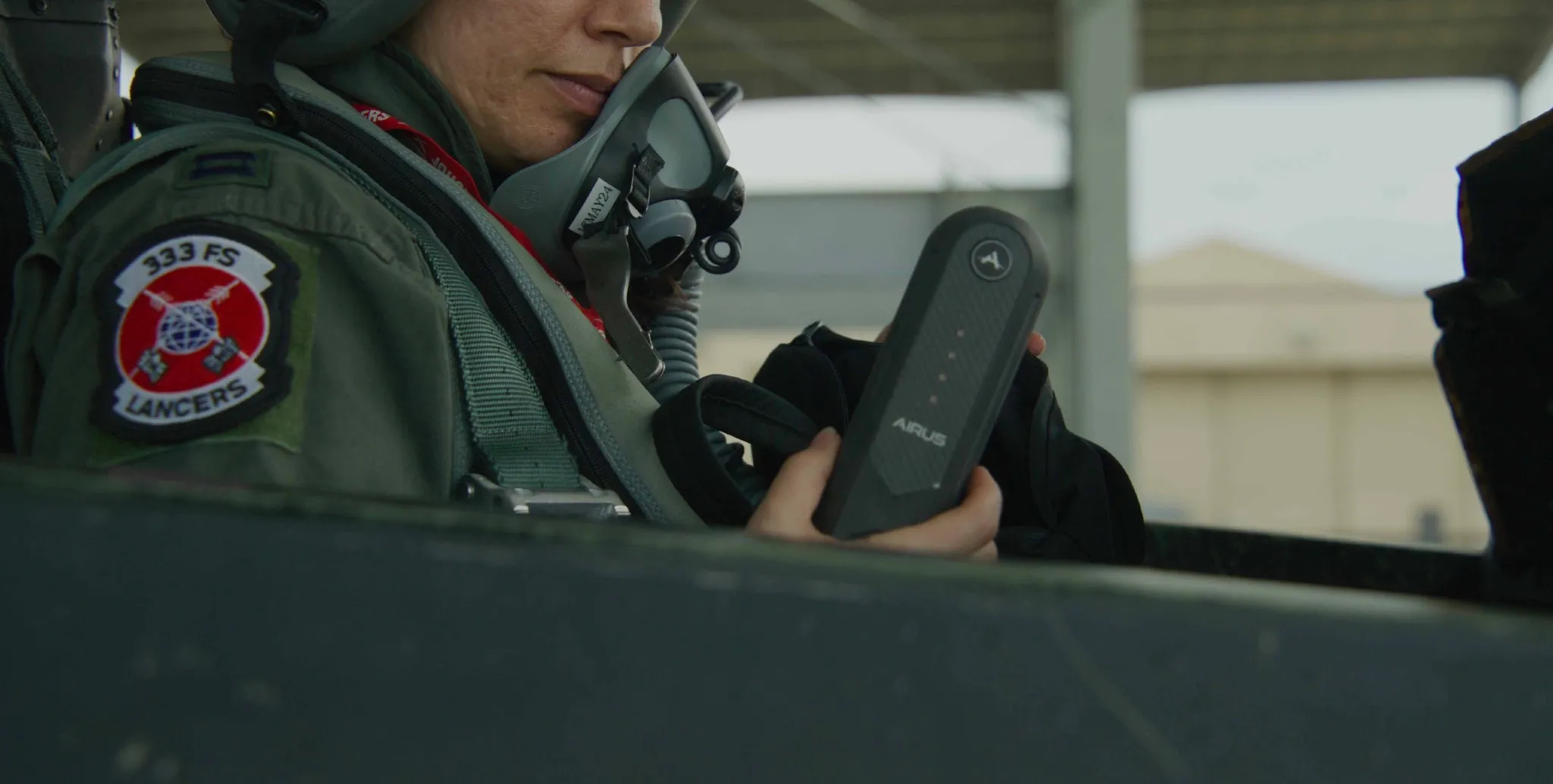
For as long as there have been ejection seats, relieving yourself in a single-seat aircraft has meant unbuckling, shifting position, and getting re-strapped correctly afterward. The stakes are not theoretical: an A-10 pilot who failed to re-secure his parachute harness after using a relief device had to eject later in the same flight. Mishaps like that are rare. The daily cost is not.
The daily cost is dehydration. A 2023 survey of Navy flyers stationed in California, Japan and Spain found nearly 93% of female pilots and aircrew said they would tactically dehydrate to avoid needing the cockpit — on sorties running as long as eight hours. Dehydrated aircrew lose up to half their G-tolerance, along with reaction time, visual acuity and judgement. There is nothing tactical about it.
The equipment was the reason. The piddle pack is a gel-filled bag holding roughly 500 mL, designed around male anatomy and largely unchanged for decades. Women were expected to make it work, which in practice meant undressing in the seat or improvising — adult diapers, zip-lock bags, whatever got through the sortie. Earlier pump-driven systems failed for a more specific reason: the pumps were not sized for female flow rates, so they were overwhelmed and leaked.
AIRUS came out of the 2020 Sky High Relief Challenge run by AFWERX, the Air Force Research Laboratory innovation program at Wright-Patterson. The brief was unusually clear: a urine collection system usable by women pilots on missions up to 16 hours. AIRION won a development contract in 2022 and the system launched in January 2025, going first to new aircrew arriving for flight training while operational units phase it in.
What shipped is seven interface shapes — five for women, two for men — a disposable pump, dual-knit fabric underwear, and a collection bag holding 1800 mL, or four to seven uses. The order of that work is the point. “It’s kind of reversed to what typical designing in the military is,” said Colt Seman, AIRION founder. “It’s usually designed for males, and then, ‘hey, yeah, we’ll make it for a female.’ This was a total opposite approach. We designed it for the females, and now the males are asking for it.”
Testing ran across F-16, F-15, A-10 and F-35 aircrew, from first-assignment aviators to lieutenant colonels. Air Combat Command’s Aircrew Performance Branch found the system did not hinder movement during critical flight maneuvers. The operator requirement was simpler than any spec sheet: use it on demand, and stay dry. “It was really a surprise how excited they were,” said Jennifer West, a former Air Force nurse and AIRION medical advisor. “I mean, we’re talking about just peeing right, which is something that we all do. That was kind of really an ‘Aha’ moment.”
The problem is older than the fix. Shelley Mendieta, a retired colonel and F-15E weapons systems officer, has worked the issue since her first deployment in 2003 and watched devices come and go. Her read on where it stands now: “this is the most positive I’ve seen this conversation in 25 years.”
- Launched
- January 2025
- Interface shapes
- Five female, two male
- Collection bag
- 1800 mL — four to seven uses
- Tested on
- F-16, F-15, A-10, F-35
- Origin
- AFWERX Sky High Relief Challenge, 2020; contract 2022
- Reported by
- Task & Purpose, April 2025
- AIRUS
- tactical dehydration
- piddle pack replacement
- female fighter pilots
- AFWERX Sky High Relief Challenge
- in-flight bladder relief